

Most of us tend to think of dietary protein sources as a source of amino acids: dietary proteins are digested by enzymes into individual amino acids that the body absorbs and incorporates into various proteins via the process of protein synthesis.
This isn’t necessarily a wrong thinking.
However, some protein sources are much more than just a source of amino acids.
One example is whey protein. The latter contains several bioactive compounds that offer additional health benefits and are the reason why you need to have a serving of whey protein a day.
What are whey protein fractions?
Whey protein is made up of different protein molecules, each with their own unique properties and functions. These protein molecules are referred to as “whey protein fractions.”
Whey protein fractions are essentially the individual components that make up whey protein. These fractions include beta-lactoglobulin, alpha-lactalbumin, immunoglobulins, lactoferrin, and glycomacropeptides. Each of these fractions can have different effects on the body.
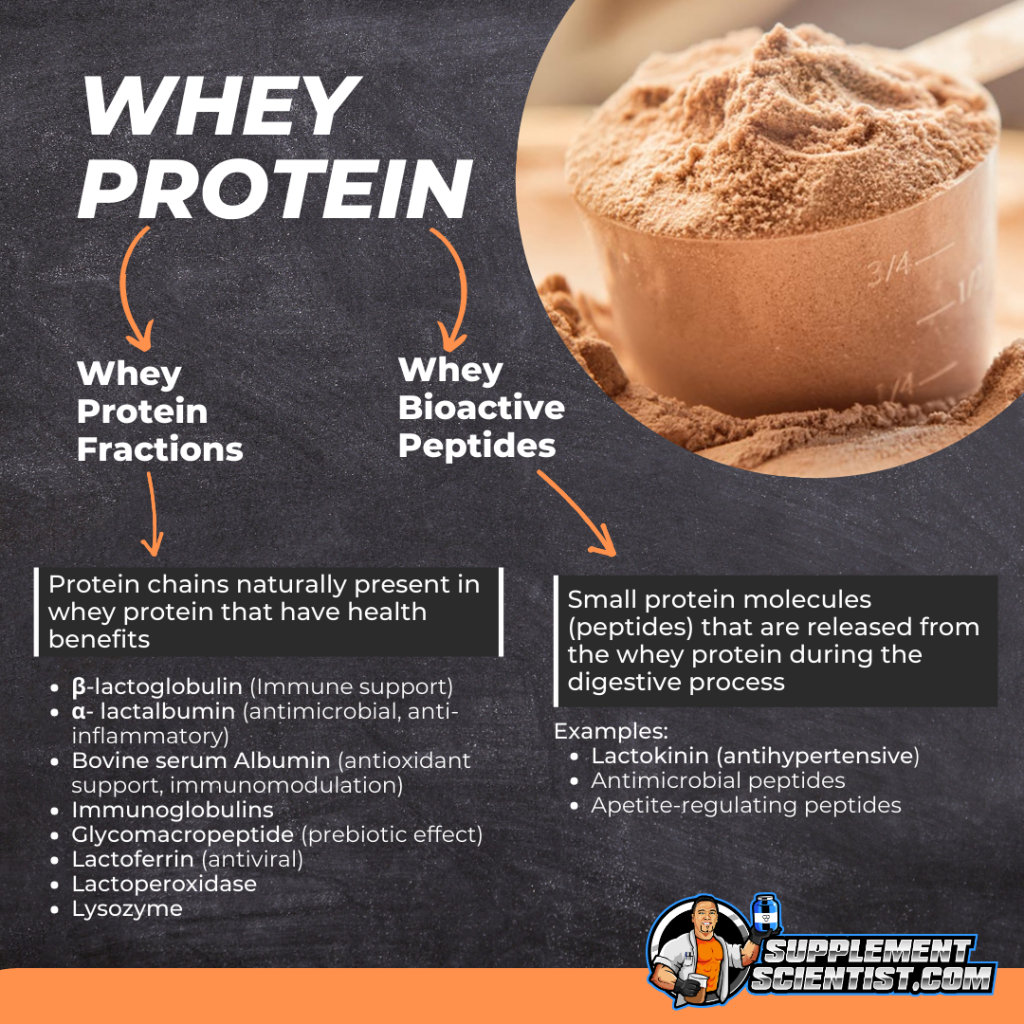
Health Benefits of some Whey protein fractions
- β-Lactoglobulin:β-Lactoglobulin is approximately 50% of the total whey protein’s content. This protein acts as transport molecules like Vitamin A and Vitamin E and may have strong antiviral activity against human immunodeficiency virus types 1 and 2.
- α-Lactalbumin: α-Lactalbumin is one of the main protein in whey that can enhance immunity in animals. This protein possesses an excellent amino acid profile, which is rich in lysine, leucine, theronine, tryptophan and cystein. Lactalbumin is proved to be 2-4 times better than egg protein and five times better than casein with regards to immunoenhancement. It can also increase Tryptophan in blood which may increase Serotonin activity in the brain which improves mental function in individuals that are susceptible to stress.
- Lactoferrin: Lactoferrin is involved in the transport of iron in the body. Also has anti-microbial activity.
- Lactoperoxidase: has antimicrobial activity
- Glycomacropeptide: have many biological and physiological properties like reduction in gastric secretion, dental plaque and dental caries inhibitor.
It’s not over. There are other benefits too!
During the process of whey digestion in the stomach, bioactive whey peptides are produced that have a range of potential health benefits beyond their nutritional value.
Bioactive whey peptides are small protein fragments that are released during the digestion of whey protein. These peptides have been shown to have various physiological effects such as antioxidant, antimicrobial, antihypertensive, immunomodulatory, and opioid-like activities.
One of the most well-known bioactive whey peptides is lactokinins, which are small peptides that have been shown to have antihypertensive properties by inhibiting the angiotensin-converting enzyme (ACE).

Source: Brandelli A et al. Whey as a source of peptides with remarkable biological activities. Food Research International. Volume 73, 2015, Pages 149-161
How to reap the health benefits of whey?
- Choose a minimally-processed whey protein. The whey protein microfractions are sensitive to heat and chemical treatment during the whey protein manufacturing process. Pasteurisation is an essential step in the processing of dairy products and some loss of microfractions due to heat is unavoidable. However, most whey proteins are derived from cheese by-products (liquid cheese whey) which must be bleached using peroxides to eliminate the cheese colourant. This bleaching can also damage the proteins. For this reason, I choose, recommend, and formulate with whey protein raw material that is made using gentler processing methods—(native whey protein) that better preserve the protein’s natural structure and eliminate the need for bleaching altogether.
- Drink milk: it is easy to forget the fact that whey protein is found in milk (about 20% of total dairy proteins) and I still remember the fact that plain old milk used to be my go-to student budget-friendly source of whey proteins and I still recommend it to those on a budget and who don’t have an issue with dairy. Let’s not also forget that milk is a great source of the slow-release Casein protein (about 80% of total dairy proteins).
Future Directions
In recent years, there has been a growing trend of adding whey protein fractions to a wide range of food and beverage products in order to boost their nutritional value and health benefits.
These are known as functional foods and functional beverages.
These products are marketed to consumers looking for convenient and easy ways to incorporate more protein and other bioactive compounds into their diets.
Examples of such products include protein bars, protein powders, sports drinks, and infant formulas. By adding whey protein fractions to these products, manufacturers are able to provide consumers with additional health benefits beyond the basic nutritional content of the product, such as immune system support, improved digestion, and enhanced muscle recovery.
Casein peptides and other functional dairy product derivatives (e.g. specialised minerals and fat derivatives) are also being considered for use in consumer products.
I got the opportunity to evaluate a few of these ingredients from reputed companies.
Challenges
While enriching products with whey protein fractions can offer potential health benefits, there are also several challenges associated with this practice.
One of the main challenges is ensuring that the whey protein fractions are stable and maintain their bioactivity throughout the manufacturing and storage process of the functional food or beverage. These fractions can be sensitive to changes in temperature, pH, and other environmental factors, which can cause them to denature or lose their functional properties.
Another challenge is ensuring that the added whey protein fractions do not negatively impact the taste, texture, or appearance of the final product. Certain fractions, such as lactoferrin, can have a bitter taste, while others can affect the color or texture of the product if added in too high a concentration.
In addition, there is also the issue of cost. Enriching products with specific whey protein fractions can be expensive, as the process of isolating and purifying these fractions can be time-consuming and require specialised equipment.
Finally, there are also regulatory considerations to take into account, as certain whey protein fractions may be subject to restrictions or limitations on their use in food and beverage products in different regions of the world.
I am keeping tab on developments in this field.

To view my Professional Profile on LinkedIn: please click here
To see my latest product creations: www.bioteenhealth.com
To view my Scientific Publications on PubMed: please click here
To get in touch, please write to: info@supplementscientist.com
Follow supplementscientist.com on Facebook: please click here
Medical disclaimer
The information presented on this website is intended for adults 18 or over. Its aim is purely educational and does not constitute medical advice. Please consult a medical or health professional before you begin any program related to exercise, nutrition, or supplementation especially if you have a medical condition. If you consume any product mentioned on our site, you do so on your own free will, and you knowingly and voluntarily accept the risks. © 2023. Supplementscientist.com
Other: The views expressed in this blog article are solely mine and may not represent the opinions or positions of any company or institution with which I am associated. Any information or opinions provided are based on my personal experiences, research, and understanding. I strive to ensure accuracy and reliability of the information provided.







Leave a Reply